The SaaSPocalypse Wasn't a Tech Story — It Was a Pricing Model Reckoning
$285 billion disappeared from SaaS valuations in 48 hours in February 2026. Most analysis blamed AI agents. The real mechanism was a 25-year pricing assumption that everyone forgot was an assumption.
In the second week of February 2026, roughly $285 billion in market cap evaporated from SaaS companies in 48 hours. Salesforce, Adobe, Atlassian, Workday — all hit at once. The financial press called it the SaaSPocalypse and blamed AI agents.
They weren't wrong. But they missed the mechanism.
AI agents didn't break SaaS software. They broke SaaS pricing. And that distinction matters enormously — whether you're buying software or building it.
The assumption nobody questioned for 25 years
Per-seat pricing is based on one premise: the human is the unit of work.
One employee does one job. They need one login. You pay for that login. This makes complete sense in a world where software is operated by people.
Salesforce became a $200B company selling that premise. Atlassian built a $50B business on it. Monday.com, Asana, Notion — the entire modern SaaS stack was priced on the assumption that the ratio of humans to tools stays roughly constant.
Nobody baked in a contingency for: what if one human runs ten agents that each do the work of a colleague?
The per-seat model had no answer. And in February 2026, the market finally priced in the fact that nobody had asked it.
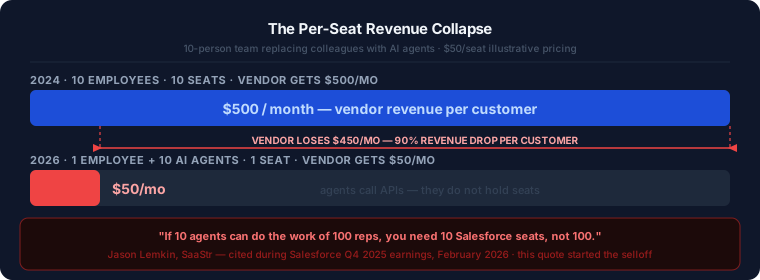
Jason Lemkin said it plainly during a discussion of Salesforce's Q4 2025 earnings: "If 10 agents can do the work of 100 reps, you need 10 Salesforce seats, not 100." That sentence is what started the selloff.
What actually happened
It wasn't one event. It was a compression of several signals that the market read simultaneously.
Anthropic shipped Claude Code and Claude Cowork — tools that let a single operator manage complex multi-step business processes without a human involved at each step. OpenAI followed with Project Operator. Atlassian reported its first-ever decline in enterprise seat counts. Workday cut 8.5% of its workforce. A company that sells workforce management software reduced its own headcount because of AI.
The market wasn't reacting to the fear that SaaS software would stop working. Jira still works. Salesforce still works. The fear was that seat-count growth — the engine behind every SaaS revenue model — had permanently decoupled from team-output growth.
When agents replace the ten people who previously needed ten seats, you don't lose the software. You lose nine of the seats. For a business built entirely on seat expansion, that is an existential change to the revenue model.
The wrong lesson most people drew
The hot take was: "SaaS is dying. Build your own tools."
That's mostly wrong — and if you act on it, you'll spend six months building a worse version of something you could have renegotiated for far less money.
The companies that dropped hardest weren't hit because their software stopped being useful. Their software still solves real problems. The issue is purely that their pricing model was designed for a world where headcount growth and seat growth are synonymous. That's the dynamic that broke. The software didn't.
There's a second wrong take: "This is about small companies." It isn't. Salesforce was a $200B company when this hit. Adobe was a $200B company. The SaaSPocalypse didn't happen to slow-moving dinosaurs. It happened to the most successful software businesses ever built, at the height of their power. That's what made the market reaction so violent.
If you're buying: three moves to make now
Audit which seats are actually held by humans. Most teams don't know this number. Pull your user list from every SaaS tool and count how many of those logins are unused, integrations, bots, or employees who haven't logged in for six months. In a large Jira or Salesforce instance, 30–40% of "users" are often in one of those categories. That number is your negotiating leverage. Your vendors already know this problem is coming.
Push for outcome-based pricing at every renewal. The smarter vendors are already offering it. Salesforce has Agentforce seats priced per agent-action. HubSpot has consumption-based tiers for AI workflows. Zendesk now offers per-resolved-ticket pricing alongside seat pricing. When you're renewing, ask directly: "Do you have a pricing model that doesn't charge per human seat?" If they don't, that's a signal about how seriously they're thinking about the next three years.
Be selective about what you rebuild internally. The current AI coding environment makes it tempting to say "we'll just build our own Notion." Sometimes that's right. More often it's a trap. The rule I use: rebuild internally only when the tool is on the critical path, the vendor has no outcome-based option, and a 70% version can be shipped in under two weeks. If any of those conditions fails, renegotiate instead.
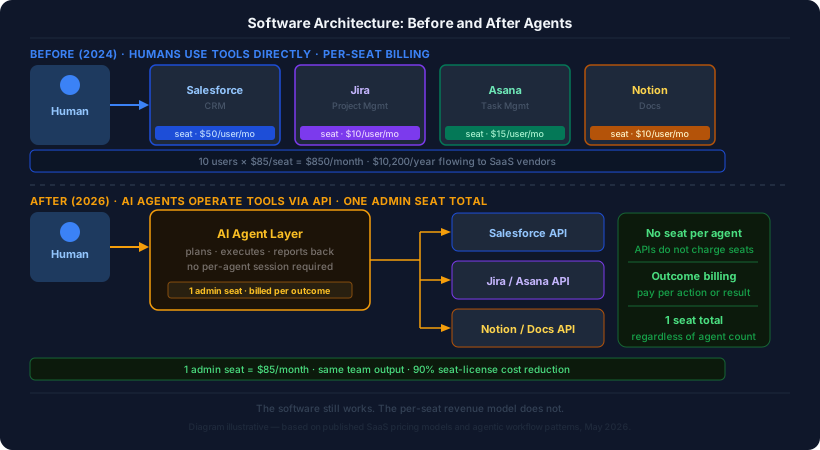
If you're building SaaS: the harder conversation
If your product is billed per seat, you need to answer a question your investors are already asking: what happens to your revenue when your customers automate with agents instead of hiring?
The companies that survive aren't the ones that resist the question. They're the ones that redesign around it before they have to.
The model emerging isn't "kill per-seat pricing." It's "price for the outcome, not the user."
- Adobe moved to Generative Credits — you pay per asset rendered, not per designer seat.
- Salesforce launched Agentforce — priced per agent action, not per rep login.
- Atlassian is rolling out usage-based billing for Jira Automation alongside seat billing, not as a replacement.
None of them abandoned per-seat entirely. They layered outcome-based pricing on top as a hedge for the transition period, where most customers still buy the old way. That's probably the right playbook for most builders too: don't rip out per-seat overnight. Add an agent tier that prices differently. Let the market tell you which model wins over the next 18 months.
The builders who are in trouble are the ones still in denial about this being a pricing problem at all — the ones treating it as an AI hype cycle that will pass. It won't. The math is structural.
The three eras of software pricing
This pattern has played out before.
The shift from perpetual licenses to per-seat SaaS happened slowly from 2008–2015, then fast. By 2018, every new enterprise software company was SaaS. By 2022, the legacy holdouts were in serious trouble. The business model change preceded the capability narrative by years — people weren't switching to SaaS because the cloud was suddenly better. They were switching because the economics of monthly recurring revenue were undeniably superior to the upgrade cycle.
We're in the same inflection point now, just compressed. The shift from per-seat to outcome/usage-based started in infrastructure (AWS, Stripe, and Twilio priced on usage from day one) and is now reaching productivity software. The timeline is shorter because the forcing function — AI agents that genuinely replace human operators — arrived faster than anyone modeled.
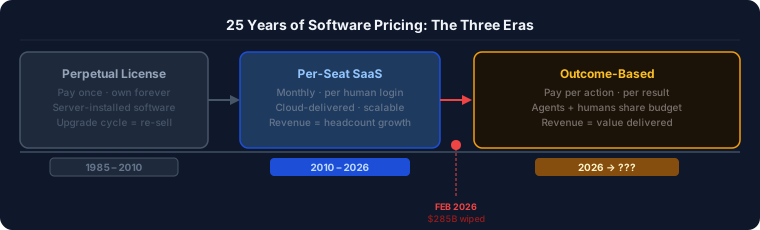
The key difference from the last transition: this one is hitting incumbents at peak power, not during the challenger phase. That's why the market reaction was sharper. Investors weren't pricing in a gradual shift. They were repricing the assumption that the dominant revenue model was safe.
What the "data moat" crowd is getting wrong
Another popular take from February 2026: "proprietary data saves you." The argument is that even if AI makes software cheaper to build, your unique data gives you a moat nobody can replicate.
This is true but incomplete. A data moat does not protect a broken pricing model. You can have unmatched proprietary data and still face structural revenue decline if you're charging for seats that your customers are replacing with one agent.
The companies that come out ahead aren't the ones with the best data or the best pricing model. They need both. Data lets you build features nobody else can build. Pricing determines whether you capture the value from those features.
LinkedIn has irreplaceable data on the professional graph. But if they don't build a pricing model for a world where one recruiter runs ten sourcing agents, that data advantage doesn't protect their revenue from the same math that hit Salesforce.
The one thing most coverage missed
The SaaSPocalypse was covered as a stock market story, an AI capability story, and a "build vs buy" story.
It was mostly a contracts story.
The vast majority of enterprise SaaS runs on annual contracts with per-seat pricing. Those contracts are renewing this year and next. Most procurement teams haven't updated their standard terms to account for AI agents. Most vendor sales teams are trained to sell seats, not outcomes. Most legal teams are using contract templates from 2019.
The companies that end up ahead are the ones who walk into renewal conversations with real data on how many seats they actually need, a clear alternative pricing structure they prefer, and the credibility to say: "we can build this ourselves if we can't agree on price."
Most companies can't say that last part and mean it. The ones that can — because they have engineering capacity and a clear sense of what's worth building — are in an entirely different negotiating position than they were two years ago.
That's the real strategic shift the SaaSPocalypse triggered. It didn't end SaaS. It handed leverage back to buyers who know how to use it — and put real urgency on builders who still think pricing is someone else's problem.
Market figures from public reporting in February–March 2026. Pricing examples based on published vendor pricing pages as of May 2026. No affiliate relationships with any products mentioned.
Work with me
I consult with engineering teams on AI adoption, cloud architecture, and engineering effectiveness. If this post surfaced a challenge you're facing, let's talk.
Get in touch →Related posts
Explore more on these topics: