Your Roadmap Was Built for a World Where Shipping Was Hard
AI just cut engineering cycle time by 80%. Your feature-decision process still takes three weeks. You didn't solve delivery. You exposed discovery.
A team I consulted with last quarter shipped a complete authentication overhaul in four days. Four days from spec to merged PRs, tests passing, deployed to production. Two years ago that would have been a six-week project.
Then I asked how long it took them to decide to build it.
Eight weeks.
Nobody laughed. Everyone nodded. This is the conversation every product team is having right now, usually without realizing what it means.
The math you're not running
Your roadmap was designed to manage a scarce resource: engineering time.
In 2022, if your team had a six-week cycle to ship a feature, a two-week planning lag was 33% overhead. Painful, but tolerable. Engineering was the bottleneck. You could blame missed deadlines on capacity, hiring, competing priorities — and you'd be mostly right.
In 2026, with AI-assisted development, that same team ships the same feature in four days.
Your two-week planning lag is now 350% overhead. You are spending more time deciding than building.
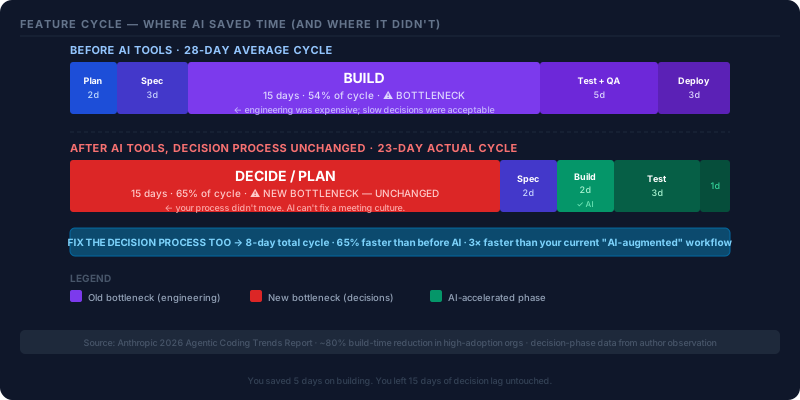
This isn't a metaphor. Anthropic's 2026 Agentic Coding Trends Report found that organizations with high AI adoption cut code-writing time by roughly 80%. Engineering cycle time — from first commit to deploy — collapsed. Meanwhile, the discovery-to-decision phase, the part that lives inside your product process, stayed exactly the same.
The teams still shipping on three-month cycles aren't bottlenecked by engineering anymore. They're bottlenecked by their own planning rituals.
Why roadmaps made sense before
I'm not saying roadmaps are stupid. They solved a real problem — and the problem changed.
The quarterly roadmap emerged from a specific constraint: engineers were expensive, rare, and switching costs were high. If you gave a team the wrong feature to build, you'd lost a quarter of capacity and couldn't easily redirect mid-sprint. Planning carefully upfront was economically rational. You were allocating a scarce, slow resource.
The roadmap is a commitment schedule. Its job is to protect engineering time from wasted work by deciding in advance what to build.
That logic holds perfectly — when building is expensive. When it isn't, the logic inverts. Careful upfront planning stops being a feature. It becomes a tax.
Three ways roadmaps now actively hurt you
1. They optimize for the wrong variable.
Roadmaps allocate engineering capacity. But engineering capacity is no longer your binding constraint. Learning velocity is. The new question isn't "what do we have time to build?" It's "how fast can we find out if this is the right thing to build?"
A roadmap answers the first question. It has no vocabulary for the second.
2. They create decision theater instead of decisions.
When your planning cycle is quarterly, you develop elaborate ceremonies to justify it: prioritization scoring, stakeholder alignment meetings, roadmap reviews, sprint planning, backlog refinement. These rituals made sense when you were committing a six-week engineering block.
They make no sense for a four-day build.
The result is that teams with AI-accelerated engineering spend more time in meetings per shipped feature than they did before. The build got faster. The ceremony didn't shrink to match.
3. They punish fast learning.
The quarterly roadmap is psychologically committed. Teams that ship in week three and discover the feature is wrong still have nine weeks left in the quarter. The roadmap creates inertia — weeks of planning, stakeholder alignment, sprint scheduling. Everything points to "keep going."
Changing direction mid-quarter feels like failure. It isn't. But the roadmap makes it feel that way, and most teams comply with the feeling rather than the data.
The experiment queue
Here's what I've seen working at teams that have actually adapted.
They don't have a roadmap. They have an experiment queue.
The difference is not cosmetic. It's architectural.
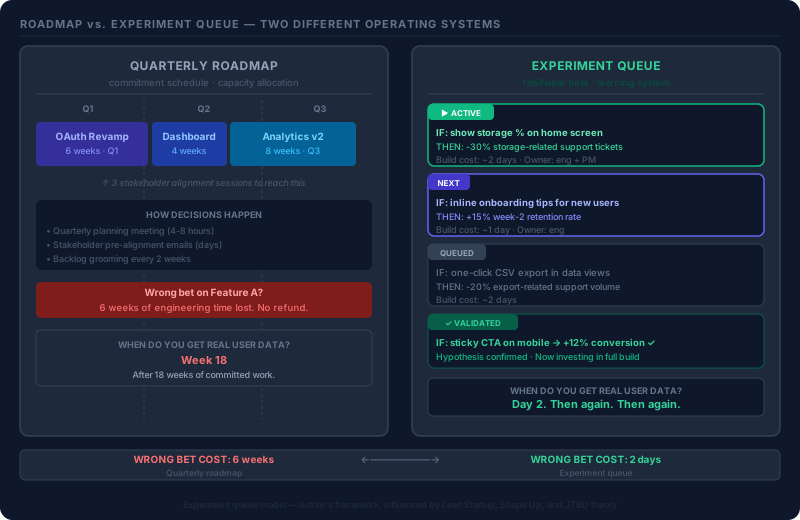
An experiment is not a feature. It has three parts:
1. The hypothesis. "We believe that showing users their storage usage on the dashboard home screen will reduce 'storage full' support tickets by 30%."
2. The success metric. A single number. Not a range. Not vibes. If you hit it, the experiment worked.
3. The build cost. With current AI tooling, estimate actual engineer-hours honestly. If it's more than two days of work, your experiment is too big. Scope it down until it fits.
The queue is a ranked list of these bets. Weekly, you pull from the top, build the experiment, and measure. If it validates, you invest further — build the full thing. If it doesn't, you discard the ticket and pull the next bet. You lost two days, not six weeks.
This process is faster than a roadmap because it fails fast. But more importantly: it makes better decisions. You're not deciding whether to build something. You're deciding whether to invest further after you've seen real evidence.
Six practices for the switch
Kill quarterly roadmaps. Replace with a rolling 6-week experiment queue. Review and re-rank weekly. This feels uncomfortable — that's data. Your team has been using planning as a security blanket against ambiguity.
Write hypotheses, not features. Every backlog item needs a falsifiable statement. "Users want dark mode" is not a hypothesis. "If we add dark mode, power users will upgrade to paid at a 15% higher rate" is.
Cap experiment scope at two days of build time. AI makes this realistic now. If an experiment takes more than two days to build, it's not an experiment — it's a project. Break it down until it fits.
Separate the experiment from the investment. A validated experiment earns an engineering investment. Build the full, polished feature after you've proven it matters. Don't polish first, then test.
Run learning retrospectives weekly, not quarterly. The decision cadence should match the build cadence. If you're shipping weekly, you should be reviewing learnings weekly.
Stop doing pre-mortems for two-day bets. Pre-mortems ("what could go wrong?") made sense for six-week engineering commitments. For a two-day experiment, the cost of a failed bet is low enough that you learn more by running it than by analyzing it. Bias for action when the bet is cheap.
The meta-point
In the old world, your competitive moat was execution speed: how fast could you translate a good idea into working software? That was genuinely hard. It required talent, process, and capital.
AI commoditized execution. Building is no longer where you differentiate.
Your competitive advantage now is decision velocity — how fast can your organization figure out what customers actually want, validate it cheaply, and double down on what works?
That is a different capability than engineering management. It's closer to epistemology: how does your organization generate and test beliefs about the market?
Teams that get this right are running twelve experiments a quarter instead of three features. They're wrong more often in absolute terms, but they're right sooner, and they accumulate learning at a rate that compounds. Eighteen months in, they don't just have better software. They have institutional knowledge about their customers that no competitor can quickly replicate.
Teams still writing twelve-page PRDs for four-day builds are not playing a different game. They're playing the right game with the wrong rulebook from five years ago.
The roadmap isn't wrong. It's just late.
The experiment queue model is influenced by Lean Startup (Ries), Shape Up (Basecamp), and Jobs-to-Be-Done theory. The 80% build-time reduction figure is from Anthropic's 2026 Agentic Coding Trends Report.
Work with me
I consult with engineering teams on AI adoption, cloud architecture, and engineering effectiveness. If this post surfaced a challenge you're facing, let's talk.
Get in touch →Related posts
Explore more on these topics: