Product Management Is the New Engineering Bottleneck. Andrew Ng Already Said It.
AI made engineers 10x faster. PMs didn't keep up. Andrew Ng named it. LinkedIn already restructured around it. Here's what your team should actually do.
A few weeks ago Andrew Ng posted something that cut right through the noise:
"I don't see product management work becoming faster at the same speed as engineering. I'm seeing this ratio shift... for the first time, when we're planning a new project, the bottleneck is no longer getting the code written."
Lenny Rachitsky amplified it. It hit differently than the usual AI discourse because it wasn't another "AI will replace developers" take — it was the inverse. Engineering got faster. Product thinking didn't.
Ng's teams could ship a feature in a weekend that would have taken six engineers three months in 2022. The constraint wasn't building. It was deciding what to build.
If you're running a product team right now and this doesn't make you slightly uncomfortable, you haven't done the math yet.
The bottleneck was always engineering. Until it wasn't.
The entire apparatus of modern product management — PRDs, sprint planning, backlog grooming, story points, quarterly roadmaps — was built on one constraint: building was expensive.
When a feature took a team of six engineers six weeks to ship, you couldn't afford to be wrong. Every misfire cost a quarter of capacity. So you compensated with process. You aligned stakeholders before starting. You wrote detailed specs to reduce interpretation errors at the handoff. You groomed the backlog so nothing got built that wasn't thoroughly vetted.
Every ritual in the product process is a rational response to expensive execution.
Now execution isn't expensive anymore.
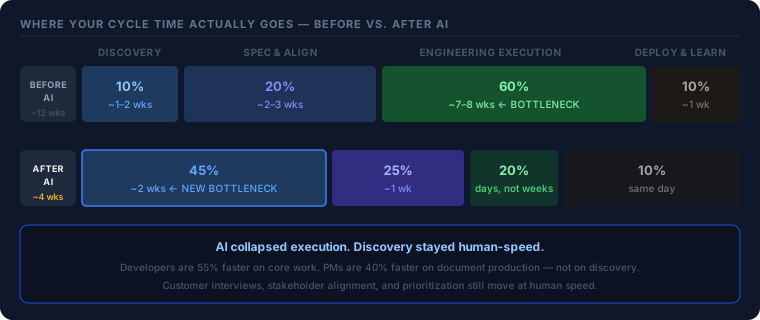
Anthropic's 2026 Agentic Coding Trends Report found that organizations with high AI adoption cut code-writing time by roughly 80%. Teams that used to ship an auth overhaul in six weeks now ship it in four days. The same report found that 27% of AI-assisted work is net new output — features that would never have been attempted at all under the old economics.
When you cut execution time by 80%, you don't just do the same thing faster. You expose what was hiding behind it.
What was hiding: discovery hadn't changed at all.
The part AI can't speed up
Here's what research is turning up, and it maps to every product team I've talked to: developers are 55% faster at core coding work. Product managers are 40% faster at document production. Not discovery. Documents.
Writing a PRD with AI? Faster. Generating a competitive analysis? Faster. Summarizing user research? Faster.
But the actual slowness in product work was never document production. It was:
- Running customer interviews and synthesizing what you actually heard vs. what you wanted to hear
- Getting three stakeholders with competing incentives to agree on a priority
- Deciding which of twelve reasonable bets to make this quarter and explaining the reasoning convincingly enough that your engineering team trusts it
- Figuring out whether what customers say they want maps to what will actually change their behavior
None of that has a meaningful AI speedup yet. You can use AI to structure your interview guide. You can't use it to replace the quality of your listening.
The 70% of PM work that lives in those activities still moves at human speed. Meanwhile, the engineering side of the loop went from twelve weeks to two.
That asymmetry is the bottleneck.
What the ratio shift actually means
For most of the past decade, the rule of thumb was roughly one PM per six to eight engineers. That ratio was designed for a world where engineering time was the constraint — more engineers, more output, and PMs had to be able to oversee a large queue of engineering work to stay relevant.
When you cut execution time by 80%, that ratio inverts.
If engineering delivers eight features in the time it used to deliver one, but the discovery process can only validate one bet per cycle, you have seven features shipping without proper validation. You're not delivering more value. You're delivering more volume, much of which misses.
The right ratio compresses. Industry analysts are already projecting a move from 1:4 toward 1:2 in the near term, with AI-first organizations trending toward 1:1 within three to five years.
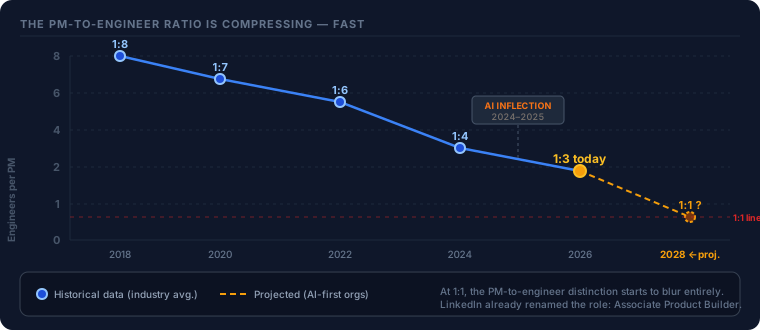
At 1:1, the distinction between PM and engineer starts to blur. Which is exactly what LinkedIn observed when they decided to act on it.
LinkedIn killed their APM program. That's your canary.
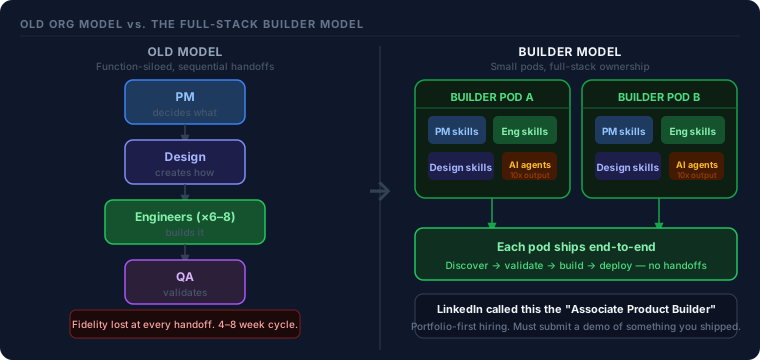
In early 2026, LinkedIn — one of the most influential product organizations in Silicon Valley — announced they were ending their Associate Product Manager program. The APM track, which had been a prestigious entry point to product careers for years, was replaced with the Associate Product Builder program.
The difference is not cosmetic.
The APB program trains people across product, design, engineering, and business simultaneously. It's portfolio-first: you apply by submitting a demo of something you've shipped, not a resume. LinkedIn CPO Tomer Cohen described it as organizing small "pods" of full-stack builders — each pod owns discovery, design, build, and deploy end-to-end, with no functional handoffs between them.
This is not a startup experiment. This is one of the largest professional networks on the planet restructuring its product org around the assumption that the PM role as a coordination-only function is obsolete.
LinkedIn isn't predicting this future. They're staffing for it right now.
What this means, depending on who you are
If you're an engineering manager: Your team is probably still structured around the old constraint. You have too many engineers per PM if product discovery is your actual bottleneck. The symptom is: things get built, but too many of them turn out to be wrong, or they drift from what was intended because the PM wasn't close enough to the work. Consider whether you need a leaner engineering team with more PM bandwidth rather than more engineers with the same PM coverage.
If you're a PM: The parts of your job that were administrative overhead — ticket writing, backlog management, status updates — are going away. What's left is the part that actually mattered: figuring out what customers need before they can articulate it, making judgment calls in ambiguous situations, and building conviction about bets that don't yet have data behind them. That's the job now, and it requires being closer to the work, not further from it. Build something. Ship something. Stop waiting for engineering to tell you whether an idea is feasible — go find out.
If you're a founder building your first product team: Hire one product thinker for every one to two engineers, not one for every eight. Hire builders who can work across functions, not specialists who hand off to each other. Airfocus and other product tools are already reporting that teams which build cross-functional pods discover problems and ship working solutions in a fraction of the time of their siloed counterparts.
If you're a non-technical person wondering how to stay relevant: The engineering side of the loop is commoditizing. The product thinking side is the scarce resource. If you can develop genuine customer empathy, make clear decisions under uncertainty, and translate ambiguous problems into clear bets — you're more valuable in 2026 than you were in 2022, not less. The tools that used to require engineers are now accessible to you. What you bring that's irreplaceable is the judgment.
The counter-argument (and why it doesn't land)
The obvious pushback is: AI will speed up discovery too. You can use AI to synthesize qualitative research, identify patterns in support tickets, generate user personas from behavioral data.
This is true. AI tools are genuinely improving the document and synthesis parts of discovery work.
But discovery isn't primarily a synthesis problem. It's an insight problem. The hard part isn't summarizing what customers said — it's knowing which customers to talk to, what questions to ask, and whether the answer you got reflects a real behavior change or just tells you what you wanted to hear.
More importantly: even if AI cuts discovery time by 40%, engineering execution time is down 80%. The gap is structural. Discovery is still the constraint.
The one scenario that changes this is AI that can run product experiments autonomously — automatically generating hypotheses, building lightweight tests, running them on real users, and interpreting the results without a human in the loop. That capability exists at the margins today. When it matures, you have a different conversation. But the companies that will be positioned to use it are the ones that have spent the next two years building tight discovery-to-validation loops, not the ones still optimizing engineering throughput.
The meta-point
Most companies are optimizing the wrong half of the product loop.
They're adding AI to engineering — copilots, agents, code reviewers — and measuring success by lines of code shipped or PRs merged per week. Those metrics are going up. The metrics that matter — customer retention, activation rates, the percentage of shipped features that users actually adopt — are often flat or declining.
You're making the fast part faster. The slow part is still slow.
Andrew Ng named the bottleneck. LinkedIn restructured around it. The teams that figure this out in the next twelve months will have a two-year head start on the ones still writing twelve-page PRDs for four-day builds.
Discovery is the constraint. Staff accordingly.
Sources: Andrew Ng on X · Lenny Rachitsky on X · LinkedIn APB announcement · Airfocus on the PM bottleneck · Bagel.ai: Andrew Ng is right · Anthropic 2026 Agentic Coding Trends Report
Work with me
I consult with engineering teams on AI adoption, cloud architecture, and engineering effectiveness. If this post surfaced a challenge you're facing, let's talk.
Get in touch →Related posts
Explore more on these topics: