The Delegation Gap: You're Using AI Like a Junior Dev When You Could Run a Whole Team
Anthropic's 2026 Agentic Coding Trends Report shows devs use AI in 60% of their work but fully delegate only 0–20% of tasks. Here's the exact playbook to close that gap with Claude Code Agent Teams.
Anthropic's 2026 Agentic Coding Trends Report buried a number that should be uncomfortable for every engineer who thinks they're "using AI": developers now involve AI in roughly 60% of their work — but fully delegate only 0–20% of tasks.
That gap has a name. I'm calling it the delegation gap, and it's the reason your team is still shipping at the same pace it did two years ago despite adopting every new tool that came out.
I've spent the last several weeks running Claude Code Agent Teams on real production features. What I've found isn't that the model is smarter than I expected — it's that the bottleneck was never the model. It was me.
You're stuck in assistant mode
Audit how you use AI coding tools today. Be honest. For most developers the interaction looks like this:
- "Write this function."
- "Fix this bug."
- "Add tests for this component."
- "Explain what this does."
One prompt. One output. You review, accept or reject, move on. Repeat for every small task throughout the day.
This is assistant mode. The AI is an exceptionally fast, mostly reliable junior dev sitting next to you — and you're narrating every step of the work to it. You're not delegating. You're dictating with extra steps.
The problem is structural, not technological. You could do more with the tools you already have — you're just not asking them to do it.
What full delegation actually looks like
Full delegation isn't "write the auth function." Full delegation is:
Implement the forgot-password flow. The endpoint should accept an email, generate a signed 15-minute token, store it in the
password_resetstable (seebackend/schema.sql), call the mailer service atsrc/services/mailer.ts, and return 204. Write unit tests covering success, unknown email, and expired token. Follow the pattern used in the login flow atsrc/auth/login.ts. Done when tests are green.
That brief has: scope, constraints, dependencies, a reference implementation, and a definition of done. It's what you'd hand to a human engineer you trust.
This is the level of specificity that unlocks AI agents. Without it, you're not delegating — you're vaguely gesturing and then fixing whatever comes back.
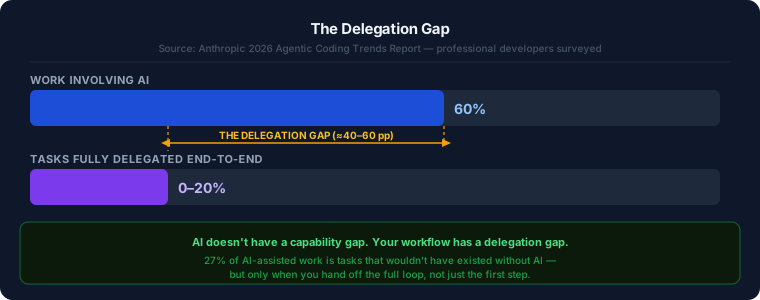
The report found that 27% of AI-assisted work is tasks that wouldn't have been attempted at all without AI. Not faster — entirely new work that wouldn't have happened. But that only shows up when you delegate fully. When you use AI as a one-prompt-at-a-time assistant, you're not unlocking that 27%. You're just moving slightly faster on the same backlog.
From assistant to team: what Claude Code Agent Teams actually are
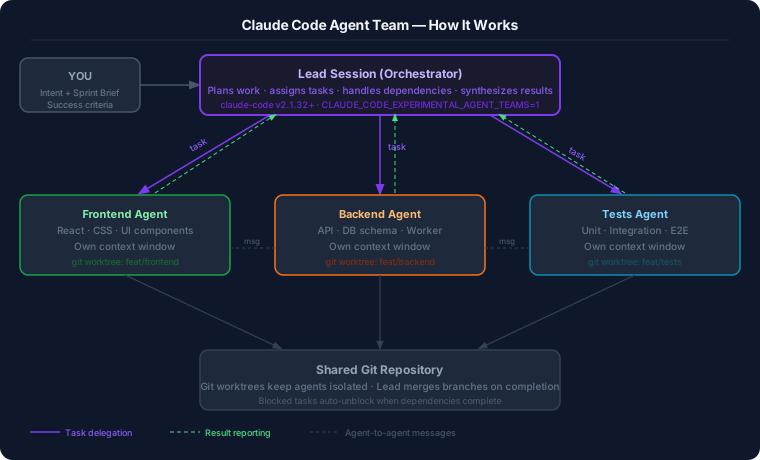
In March 2026, Claude Code v2.1.32 shipped an experimental feature called Agent Teams. The idea is straightforward: instead of one Claude Code session doing everything, you run a lead session that spawns multiple independent teammate sessions working in parallel.
Each teammate has its own context window, its own git worktree, and a specific scoped task. The lead orchestrates — it plans the work, assigns tasks, tracks dependencies, and synthesizes results when teammates report back. When teammate A finishes the database schema, teammate B (which was blocked on it) automatically unblocks and starts.
This is qualitatively different from just opening multiple terminal tabs with Claude Code. The sessions communicate. Dependencies are tracked automatically. The lead knows what's blocked, what's done, and what can be reassigned.
Anthropic's own testing found that unguided agent team attempts succeed about 33% of the time. That number jumps dramatically when you give them structure before execution starts. The difference between a team that ships and one that spins in circles isn't the model — it's the brief you write before spawning the first agent.
The setup
Enable agent teams with one environment variable:
# Add to your project's .claude/settings.json
{
  "env": {
    "CLAUDE_CODE_EXPERIMENTAL_AGENT_TEAMS": "1"
  }
}
Requires Claude Code v2.1.32 or later. Once enabled, describe the team structure in natural language when you start a session — Claude handles spawning, assignment, and coordination.
Here's the brief template I've settled on after a few weeks of iteration:
Build [feature name].

Team:
- Backend Agent: [specific scope]. Follow patterns in [reference path].
  Success: [definition of done].
- Frontend Agent: [specific scope]. Depends on Backend Agent's API shape.
  Start after Backend Agent posts the route contract.
  Success: [definition of done].
- Tests Agent: Write unit and integration tests for [scope].
  Run them and fix failures. Success: green CI.

Constraints:
- Do not modify [existing files/services you want protected]
- Use the error handling pattern from [reference file]
- Each agent commits to its own branch: feat/[agent-name]-[feature]

Planning phase first: Backend Agent writes the API contract as a comment
in the thread before Frontend Agent starts implementation.
The planning phase instruction is non-negotiable. I've shipped several features where I skipped it, and every time the Frontend Agent either blocked on the missing shape or made assumptions that conflicted with what the Backend Agent built. One extra minute of spec costs far less than untangling a merge conflict between two agents that were technically "done."
What to delegate to an agent team
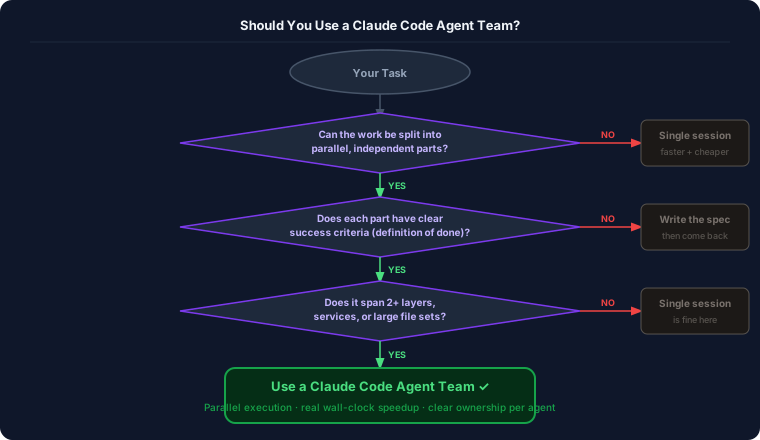
Not everything should go to a team. The token cost and coordination overhead are real. The high-value cases:
Full features that span multiple layers. A feature touching API + UI + tests is the canonical use case. Each layer goes to a separate agent, running in parallel. The feature that would take 3 hours of sequential back-and-forth can be ready to review in 45 minutes.
Large test coverage gaps. "Write comprehensive tests for the billing module" — split by test type (unit, integration, E2E) across three agents. Each agent has a clear scope and a clear success condition (tests pass, coverage at X%).
Parallel research on a hard bug. Got a mysterious slowdown and three competing hypotheses? Put one agent on each hypothesis. You get three independent investigations in the time it would take to run one.
Cross-cutting refactors. Renaming a pattern or extracting a shared abstraction across 40 files. Let each agent own a section of the codebase. They don't step on each other's worktrees.
And what not to delegate:
Architecture decisions. Decide the structure yourself. The agent team executes — it doesn't architect. Hand them a shape; let them fill it in.
Tasks with fuzzy success criteria. "Make the onboarding feel better" produces three agents with three different interpretations of "better." Sharpen the goal before you delegate anything.
Anything touching production credentials or live infrastructure. Agents work in worktrees on local code. If your task requires SSH access to a production box or a live DB query, that's not delegation — that's writing a runbook. Write the runbook yourself.
Security-sensitive decisions. Auth flows, permission checks, input validation — the shape of these should be decided by a human. An agent can implement what you've specified. It shouldn't be specifying it.
The coordination tax
I want to be direct about the cost because most posts about multi-agent systems are still in the honeymoon phase.
Token usage scales linearly with team size. A 3-agent team running a 2-hour feature is roughly 3× the token cost of a single session on the same work. If you're running many teams across a sprint, that bill compounds. Run the math before you make it a default workflow.
The lead session has overhead too. Planning, dependency tracking, and synthesizing results from teammates all consume tokens before a single line of production code is written. For a well-scoped 30-minute task, that overhead isn't worth it. Use a team when the parallelism produces real wall-clock speedup on work that matters.
Badly scoped tasks produce agents that block each other. Two agents editing the same file because you gave them overlapping scope is not a theoretical problem — I hit it on my second attempt. The brief structure I shared above is the direct result of debugging that. Scoping is the job you can't outsource.
The math that makes it worth it: your time is not free. A 3-hour solo feature that becomes a 45-minute agent team run — even if the tokens cost $3–5 more — is a straightforward win for anything on your actual roadmap. The break-even is low. The traps are vague tasks and over-teaming routine work.
The real unlock isn't the tooling
Here's the insight from Anthropic's report that most people read past: the engineers getting outsized output from agentic tools are not better at prompting. They're better at building structure before execution starts.
They write specs before they open Claude Code. They define the API contract before they describe the UI. They know what "done" looks like before they write the first line of a brief.
This is just good engineering practice — and it turns out AI exposure is one of the fastest ways to reveal whether you actually have it. When a single-session Claude Code chat produces vague results, you can blame the model. When a 3-agent team goes sideways, the failure mode is always visible: the brief was underspecified, the scope overlapped, or there was no definition of done.
The delegation gap isn't a capability problem. It's a clarity problem. AI exposes the places where human engineering process is vague — faster, and more expensively, than a slow-moving quarterly planning cycle.
Where to start: Pick one real feature in your next sprint. Write the full brief — scope per layer, success criteria per agent, dependencies explicit, reference implementations cited. Hand it to a 2-3 agent team. Review the diff.
You'll close the gap faster than you think. And more importantly, you'll feel exactly where your process was always loose — you just weren't shipping fast enough to notice.
Sources: Anthropic 2026 Agentic Coding Trends Report · Claude Code Agent Teams Documentation · Gartner Developer Survey 2026 (87% daily LLM tool usage) · Anthropic Engineering: Building a C Compiler with Parallel Claudes
Work with me
I consult with engineering teams on AI adoption, cloud architecture, and engineering effectiveness. If this post surfaced a challenge you're facing, let's talk.
Get in touch →Related posts
Explore more on these topics: