Your AI Agent Has a 90% Step Score. Here's Why It's Failing 65% of Runs.
A 10-step AI agent pipeline at 90% per-step reliability succeeds only 35% of the time. This is the compounding reliability math that explains why 78% of companies run pilots but only 14% ship agents to production — and the architecture that closes the gap.
The demo always works.
You show the stakeholders a 10-step agentic workflow. It nails the first run. Nails the second. The room gets excited. Someone says "this is going to production next month." You agree.
Three months later, you have a pilot that works 30% of the time and a team that's convinced the model is broken.
The model isn't broken. You have a math problem, and nobody on your team has named it yet.
The number that explains everything
A 2026 survey of 650 enterprise technology leaders found that 78% have at least one AI agent pilot running, but only 14% have successfully scaled an agent to organisation-wide production use. That's not a model capability gap. Models got dramatically more capable between the survey's baseline and today. The gap is engineering.
Here is the math behind it.
Say you build a 10-step agent pipeline. At each step, your agent uses an LLM call, some tool use, maybe a retrieval step. You evaluate step quality and find that each step succeeds — meaning it produces a correct, useful output — 90% of the time. That feels great. 90% accurate is strong by most engineering standards.
Now ask: what's the probability that all 10 steps succeed?
P(all steps succeed) = 0.90^10 = 0.349
Your 90%-accurate-per-step pipeline succeeds end-to-end 34.9% of the time. You're failing on roughly two out of three production runs — not because the model is bad at individual tasks, but because you're multiplying 10 independent failure probabilities together.
This is the compounding reliability problem. It's not a bug. It's arithmetic.
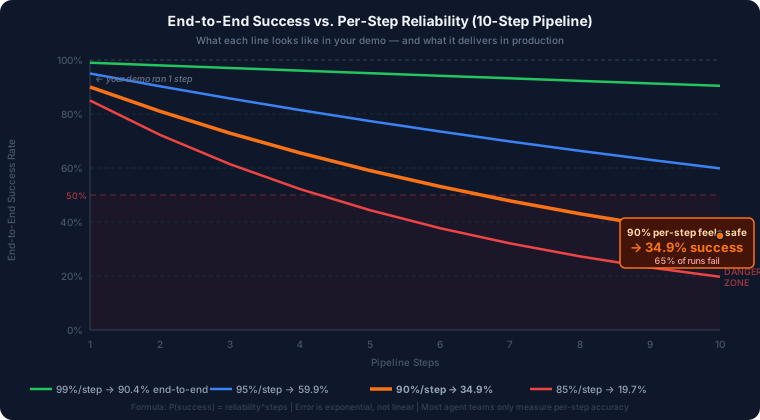
The chart above makes the shape of the problem visible. Notice the orange line — 90% per step, which sounds like a high-quality system. By step 5 it's already below 60%. By step 10 it's at 35%. If you're running a 20-step pipeline at 90% per step, you're succeeding 12% of the time. One in eight runs.
The 99% per-step green line is the only one that stays above 80% at 10 steps. That's the benchmark the 14% who ship actually aim for — and they achieve it not by finding a better model, but by engineering for reliability at the system level.
Most teams only measure per-step accuracy. That number is almost always reassuring. The end-to-end number is almost always alarming. The gap between them is where pilots go to die.
The three patterns that account for most failures
Across the 650-enterprise dataset, three failure modes account for the majority of pipeline collapses. They're worth naming because they're distinct problems with distinct fixes.
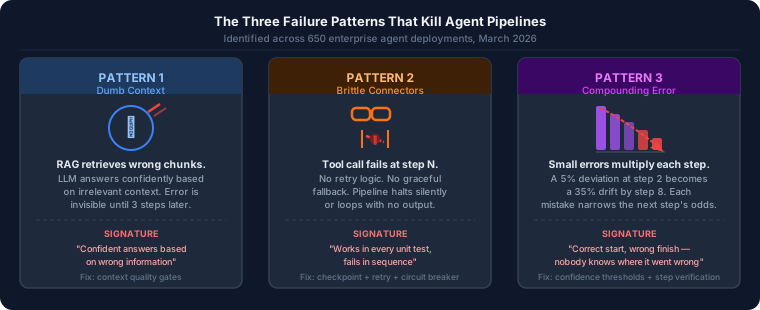
Pattern 1: Dumb Context. Your RAG layer retrieves technically related chunks that aren't actually useful for the current step. The LLM responds confidently — it has no way to signal "I'm not sure this context is right" — and the error is invisible until the output is already wrong two steps downstream. Context volume is not the same as context quality. Most teams optimize for the former and ignore the latter.
The tell: outputs that are plausible but subtly wrong in ways that look like model mistakes. They're not. The model did exactly what it was asked to do with bad inputs.
Pattern 2: Brittle Connectors. The agent's tool integrations work perfectly in isolation and in your test harness. Then you run them in a live sequence and something external changes — an API rate limit, a momentary timeout, a schema drift in an upstream service. There's no retry logic, no graceful fallback, and the pipeline either halts silently or loops until it hits a timeout. You find out from the user, not from your monitoring.
The tell: failures that are reproducible only under concurrent load or in production environments, never in dev.
Pattern 3: Compounding Error. Individual steps are correct. But a small deviation in step 2 — a slightly wrong interpretation of the task scope — propagates forward. Each subsequent step's output is conditioned on the previous step's. By step 7, the agent is working confidently on the wrong problem. The end state looks like a model hallucination. It isn't. It's accumulated drift.
The tell: the agent finishes, the output is complete and coherent, and it's completely wrong.
Datadog's 2026 State of AI Engineering report found that context quality — not context volume — is the limiting factor for most agent deployments. The majority of teams don't use anywhere near their model's full context window; what they're missing is the discipline to evaluate whether the context they're injecting is actually the right context for the current step.
Why 85% per step isn't "good enough"
I want to belabor the math for one more paragraph because I've watched too many experienced engineers misestimate this.
At 85% per step — which, to be clear, is a solid number — a 10-step pipeline succeeds 19.7% of the time. Less than one in five runs. A 20-step pipeline at 85% succeeds 3.9% of the time. That's not a system you can ship. That's a system that has a 96% failure rate.
At 95% per step, a 10-step pipeline succeeds 59.9% of the time. Still barely majority passing. At 99% per step — which requires a serious reliability engineering investment — a 10-step pipeline succeeds 90.4% of the time and a 20-step pipeline succeeds 81.8% of the time.
The target for any agentic system you intend to ship isn't 90% per step. It's 99% per step. And that number doesn't come from the model. It comes from the architecture around the model.
The architecture that gets you to 99% per step
The 14% who successfully scale AI agents don't have better models. They have better pipelines. The core pattern looks like this:
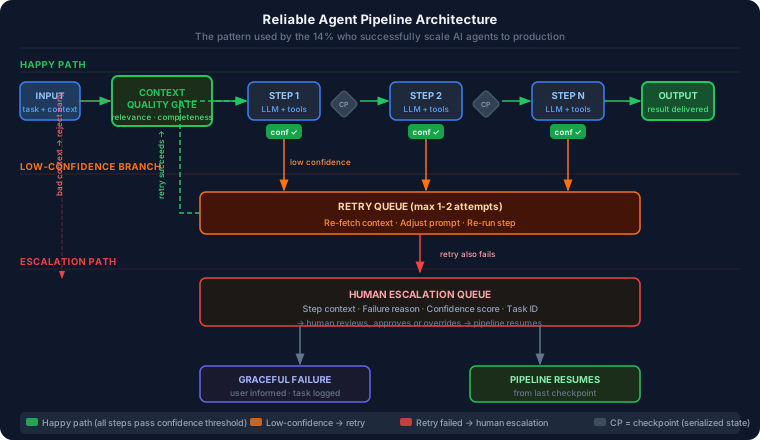
Four components separate the reliable pipelines from the demo-only ones:
1. Context Quality Gate at the input layer.
Before the pipeline starts, validate that the context being injected is fit for purpose. This means:
- Relevance scoring: does retrieved content actually address the current task?
- Completeness check: are there known dependencies the context doesn't cover?
- Freshness gate: is the context recent enough to be trusted for time-sensitive steps?
Fail fast here. An agent that starts with bad context is guaranteed to produce bad outputs. The right behavior is to reject or re-fetch before spending any compute on the downstream steps. This alone prevents a substantial fraction of Dumb Context failures.
2. Confidence scoring at each step, not just at the output.
After each step, score the output quality before passing it to the next step. This is not the same as checking whether the LLM returned a response — it returned one, it always does. What you're checking is whether the output meets the criteria for that specific step.
Practically, this means defining a confidence threshold per step type and having either a separate LLM evaluation call or a deterministic validator verify the output before it flows forward. If confidence is below threshold, route to retry before proceeding.
async def execute_step(step_fn, context, threshold=0.85):
    output = await step_fn(context)
    confidence = await evaluate_confidence(output, context)

    if confidence >= threshold:
        return output, "pass"

    # one retry with enriched context
    enriched = await re_fetch_context(context)
    output = await step_fn(enriched)
    confidence = await evaluate_confidence(output, enriched)

    if confidence >= threshold:
        return output, "retry_pass"

    return output, "escalate"
This pattern catches Compounding Error early. A 5% deviation at step 2 fails its confidence check, gets one retry, and either corrects or escalates — instead of propagating that 5% error forward for 8 more steps.
3. Checkpoint after every step, not just at the end.
Serialize the agent's state to storage after each step. Not the full context window — the structured state: what step you're on, what the step produced, what the task parameters are, what decisions were made.
On any failure, restart from the last checkpoint rather than from scratch. On a 10-step pipeline, a failure at step 8 that requires a restart from step 8 (not step 1) is the difference between one extra step of compute and losing the entire run.
This addresses Brittle Connectors. When the API timeout hits step 6, you don't lose steps 1–5. You resume from step 6 once the transient issue resolves.
4. A structured human escalation path, not a blank error state.
When retry fails, the agent needs somewhere to go. That place is a human escalation queue — not an exception log, not a silent failure, and not a "please try again" message to the user.
The escalation entry should include: the step that failed, the confidence score, the task context, the last known good state (checkpoint), and the specific reason for failure. This gives a human reviewer enough information to either approve a modified output, supply missing context, or terminate the task gracefully.
This is the pattern Temporal.io calls "durable execution" — the idea that a workflow's progress should survive any individual step's failure, and that humans are a valid step in the workflow rather than an escape hatch from it.
What the 14% do differently
Looking across the teams that successfully ship: none of them achieved 99% per-step reliability by accident. They treated reliability as an engineering discipline, not a model property. A few specific practices separate them:
They measure end-to-end success rate, not step-level accuracy. This sounds obvious. It's rare. Most monitoring dashboards show per-step metrics because they're easier to instrument. End-to-end success requires running the full pipeline under production conditions, which is slower and less pleasant to track. Do it anyway. It's the only metric that actually correlates with user outcomes.
They set thresholds before deployment, not after failure. Confidence thresholds that are retrofitted after a production incident are always too conservative in some areas and too permissive in others because they're tuned to the specific failure that surfaced, not the failure distribution. Define thresholds during design, calibrate them on a held-out set of representative tasks, and revisit them quarterly.
They build the escalation path on day one. Teams that add human escalation as an afterthought invariably build a bad one — the queue is hard to process, the information in it is insufficient, and the humans who receive escalations don't know what to do with them. The teams that get this right co-design the escalation path with whoever owns the human review work, before the first production run.
They run chaos tests on their connectors. Step reliability degrades under load, rate limits, and transient network conditions that never appear in a dev environment. The teams that ship simulate connector failures in staging — random API timeouts, schema drift, rate limit responses — and validate that their retry and checkpoint logic handles them correctly before they handle them in production.
What this means if you're not an engineer
If you're a product manager, a founder, or an operator evaluating an AI agent product or deciding whether to invest in building one: the right question to ask is not "what's the model's accuracy on the demo tasks?" It's "what's the end-to-end success rate on a 10-step production run, and what does the pipeline do when a step fails?"
An agent that fails 65% of the time is not an AI problem. It's an infrastructure gap, and it has a well-defined engineering solution. The models are capable. What companies are mostly missing is the discipline to build the scaffolding around them — context gates, confidence scoring, checkpoints, escalation queues — that makes the math work.
Gartner's 2026 forecast predicts that over 40% of agentic AI projects will be cancelled by end of 2027, not because model capability is insufficient, but because the engineering problems that make agents break at scale remain unsolved. The cancellations won't be model failures. They'll be architecture failures.
The pilot success rate — 78% pilots, 14% shipped — will improve not when models get better, but when teams stop optimizing the demo and start engineering the production path.
The demo is a controlled environment with one happy-path run. Production is a stochastic system with compounding probability. The distance between them is not marketing — it's arithmetic. Treat it like one.
Data sources: Datadog State of AI Engineering 2026 · Temporal.io on AI reliability and durable execution · AscentCore: AI Agents Are One Update Away from Breaking (May 2026) · DEV Community: The AI Agent Reliability Gap in 2026 · Lightrun 2026 State of AI-Powered Engineering Report via VentureBeat
Work with me
I consult with engineering teams on AI adoption, cloud architecture, and engineering effectiveness. If this post surfaced a challenge you're facing, let's talk.
Get in touch →Related posts
Explore more on these topics: