Your AI Agent Has Amnesia. Here's the Architecture That Fixes It.
Long-running agents fail 90% more often without state persistence. This is the memory architecture — working, episodic, semantic, procedural — that makes stateful AI production-ready.
There's a reason your demo looked great and your production agent keeps failing.
The demo ran in one session, one prompt, one context window. Production has users who come back the next day, tasks that run for hours across restarts, and agents that need to know what they decided two steps ago before they decide anything now.
The model hasn't changed. The problem is that you're running it like a calculator — stateless, context-free, amnesiac — and then wondering why it keeps making the same mistake it made yesterday.
This is the memory problem, and it's now the single most common failure mode for agents graduating from demo to production. A 2026 analysis of long-running agent deployments found that agents running for more than four hours have a 90% higher risk of total task failure without state persistence in place. Not degraded quality. Complete failure — the agent loses track of what it was doing and either loops, halts, or goes off-script.
Most teams hit this at the worst possible moment: a customer-facing agent forgets a user preference it acknowledged three turns ago, or an autonomous coding agent refactors a module it already touched and creates a conflict, or a workflow agent loses its checkpoint after an API timeout and starts the whole task over from scratch.
The fix isn't complicated, but it requires treating memory as a first-class architectural component — not an afterthought you bolt on after the model is "working."
Why stateless was fine — until it wasn't
For the first few years of LLM adoption, stateless was fine because the use cases were short: answer a question, draft an email, summarize a document. The context window was big enough. The session was the job.
Agents broke that assumption. An agent isn't doing one thing — it's doing a sequence of things, often over a long time horizon, often with interruptions. The context window runs out. Sessions restart. Sub-agents need to share knowledge. The human who started the task isn't the same one who checks on it four hours later.
The LLM is still a context window — a fixed chunk of tokens that gets wiped every session. That's not changing anytime soon. What changes is what you put around it.
The four types of agent memory
This is the taxonomy the field has converged on. Each layer maps to a different engineering problem.
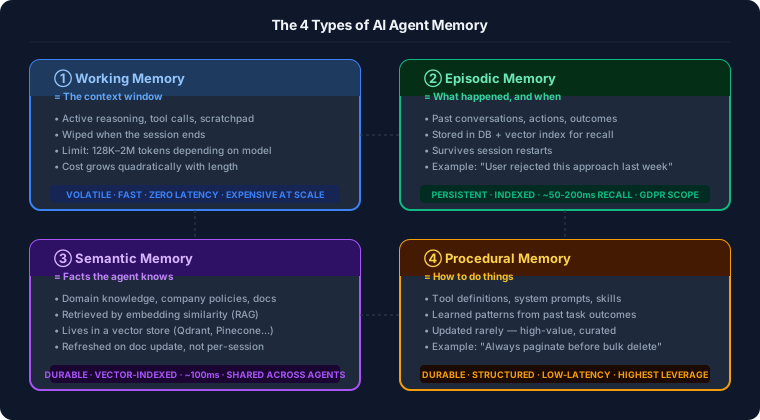
Working memory is the context window. It's where the agent thinks right now. Fast, zero-latency, and volatile — everything in it disappears when the session ends. Costs grow quadratically with token count, which means you can't just pack everything in here and call it a memory solution. This is where most naive implementations stop.
Episodic memory is the history of what happened. Past conversations, past actions, outcomes — the "I remember this user told me X last Tuesday" layer. It lives in a database (Postgres, DynamoDB, whatever you already have) with a vector index for fuzzy recall. It persists across sessions and must support deletion — because users have a right to be forgotten, and so does your compliance posture.
Semantic memory is what the agent knows about the domain. Policies, product documentation, API specs, company knowledge. This is the RAG layer, stored in a vector database (Qdrant, Pinecone, pgvector). It gets updated when docs change, not when sessions run. One important benchmark: RAG-style semantic retrieval is 1,250× cheaper and 45× faster than shoving the same content directly into a long context window. If you're doing the latter, you are paying a large tax for no quality gain.
Procedural memory is how the agent knows how to do things. Tool definitions, system prompts, learned workflows, skill templates. These are the agent's habits — updated rarely and deliberately, not per-session. This is the highest-leverage layer because a well-curated procedural store means you don't have to re-specify behavior every time. A bad one means every agent run starts from scratch with a blank slate of judgment.
The production architecture
The piece most teams skip is the memory router and context compiler — the layer between the agent's reasoning loop and the memory stores. Without this, you end up with three anti-patterns:
- The firehose: Dump everything into the context window and hope the model picks out what matters. Works in demos. Falls apart at scale when the window fills up, costs spike, and recall degrades.
- The amnesiac: No external memory at all. Each session starts cold. Users hate this. Agents make avoidable mistakes.
- The silo: Implement one memory type (usually RAG for semantic) and ignore the others. Solves knowledge retrieval but doesn't fix context loss across sessions or the procedural knowledge gap.
The router pattern solves all three. Here's what a production memory architecture actually looks like:
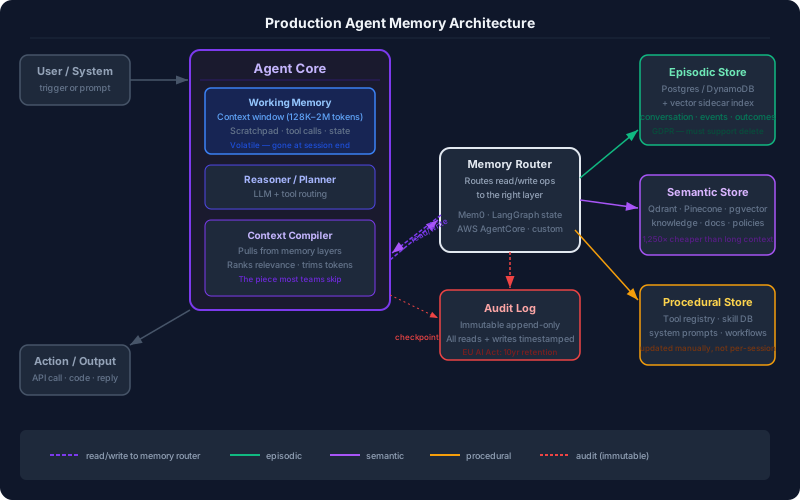
The Context Compiler is the piece nobody builds until they've been burned. Before each reasoning step, it queries the relevant memory stores, ranks the results by relevance and recency, trims to fit the available token budget, and injects the output into the working context. The agent never sees the raw stores — it sees a curated, token-efficient snapshot of what it needs right now.
Mem0's production benchmarks make the economics clear: their selective pipeline (which implements this pattern) achieves 91% lower p95 latency (1.44s vs 17.12s) and 90% fewer tokens compared to full-context approaches, with only a 6-percentage-point accuracy trade-off. For most production workloads, that trade is extremely favorable.
The three implementation paths
Path 1: DB checkpoint (simplest, covers 80% of use cases)
At each meaningful task milestone, serialize the agent's state — what it's doing, what it's decided, what's left — to a row in your existing database. On restart, load the latest checkpoint and resume from there. This is synchronous, easy to reason about, and requires nothing exotic.
# at each milestone
await db.upsert("agent_checkpoints", {
    "session_id": session_id,
    "task_id": task_id,
    "step": current_step,
    "state": json.dumps(agent_state),
    "updated_at": datetime.utcnow()
})

# on startup
checkpoint = await db.get("agent_checkpoints", task_id=task_id)
if checkpoint:
    agent_state = json.loads(checkpoint["state"])
    resume_from = checkpoint["step"]
Path 2: Event sourcing (for compliance + replay)
Instead of storing current state, store every event that mutates it. The current state is always the replay of all events. This gives you a full audit trail, the ability to replay any past run, and a natural fit with immutable audit log requirements. It's more work to implement and query, but it's the right answer when you're under any kind of regulatory obligation.
Path 3: Selective vector recall (Mem0 / LangGraph pattern)
For episodic and semantic layers, use the router to retrieve only the top-k most relevant memories per reasoning step rather than loading everything. Tune k per agent type — conversational agents usually need k=5–15 from episodic, knowledge-heavy agents need k=20–50 from semantic. The key is measuring recall quality, not just retrieval speed.
Which layer do you actually need?
Most teams overthink this. Here's a practical decision guide:
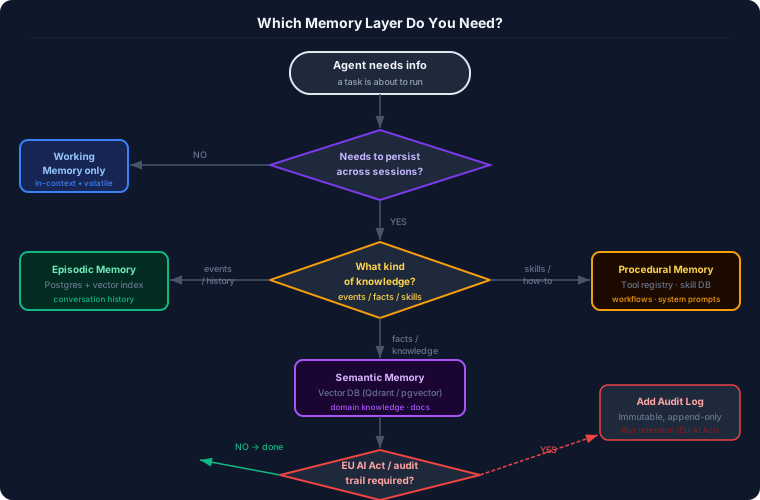
If the agent's context doesn't need to survive session restarts — working memory is enough. If users come back expecting the agent to remember them — add episodic. If the agent needs to reason over domain knowledge — add semantic (and stop putting docs in the system prompt). If the agent needs to execute learned workflows — invest in procedural. And if you're in a regulated industry or handling personal data — add the audit log from day one, not as a retrofit.
The order matters. Get checkpoint persistence working first. Vector recall can wait until you've hit the scale where the cost difference becomes real.
The compliance trap
Here's the design tension nobody mentions until it's too late: GDPR's right to be forgotten requires you to delete a user's episodic memories on request. The EU AI Act, fully in force since August 2026, requires 10-year audit trails for high-risk AI systems.
These requirements are in direct tension. You need to delete personal data on request. You also need to retain the audit record that shows the agent acted correctly.
The solution is to separate episodic memory (which contains personal data and must support deletion) from the audit log (which can be anonymized or pseudonymized). The audit log records that an agent step occurred, what type of memory was accessed, and what decision was made — without necessarily storing the raw personal content. When a deletion request comes in, you wipe episodic and semantic entries for that user, but the anonymized audit trail remains intact.
If you don't design for this upfront, retrofitting it into a production system is painful. The schema decisions you make for episodic memory (especially around user ID scoping and soft-delete support) determine whether compliance is a config change or a migration nightmare.
What this means if you're not an engineer
Product managers and founders: if your product includes any AI agent that handles multi-step tasks or interacts with users across more than one session, ask your team which memory layers are implemented. If the answer is "it's in the context window," that's working memory only — and that means every session starts cold, the agent can't learn from past interactions, and any long-running task will fail if the session is interrupted.
That's not an AI problem. It's an architecture problem, and it has a clear engineering solution. The question is whether it's in the roadmap before your first production outage — or after.
The memory problem is what happens when you put agent-scale ambitions on a context-window-scale foundation. The model isn't the bottleneck. The absence of a memory layer is. Treat it like the infrastructure it is, build the router and context compiler before you need them, and your agents will stop having amnesia on the day it costs you the most.
Architecture patterns sourced from Mem0's State of AI Agent Memory 2026, LangChain's context engineering guide, Oracle's agent memory explainer, and AWS AgentCore long-term memory deep dive.
Work with me
I consult with engineering teams on AI adoption, cloud architecture, and engineering effectiveness. If this post surfaced a challenge you're facing, let's talk.
Get in touch →Related posts
Explore more on these topics: