Clean Code Is Your AI Tax Rate
AI agents don't make your messy codebase invisible — they make it expensive. When 78% of Claude Code sessions involve multi-file edits, your architecture quality is no longer a code-quality concern. It's a cost and velocity concern.
I ran Claude Code on two codebases last month.
The first one was a three-year-old Node service that had grown by accretion. No types, no clear module boundaries, functions named handleData and doStuff, a 900-line utils.js that was everyone's junk drawer. Working in it as a human was fine — you pick up the tribal knowledge, you remember where things live.
The second was a newer TypeScript service. Strict mode on, single-responsibility modules, explicit dependency injection, named constants instead of magic strings. The kind of codebase that gets called "over-engineered" in code review by someone who's never maintained it for two years.
On the first codebase, Claude Code produced mediocre output, kept asking clarifying questions, and got confused about which version of a function was the real one. I spent more time correcting it than I would have just writing the code myself.
On the second, it shipped a complete feature — endpoint, tests, migration — in a single session. I reviewed it in ten minutes and merged it.
Same model. Same prompt quality. Different tax rate.
What "AI tax rate" actually means
Every token in a context window is either doing work or paying overhead.
In a clean codebase, an AI agent reads your typed interfaces, understands the module boundaries, finds the right place to make a change, and gets on with it. The overhead is minimal.
In a messy codebase, the agent burns tokens trying to understand what's going on. It reads the wrong files first because names are ambiguous. It re-reads the same 900-line god object three times because it can't tell which part is relevant. It encounters an untyped function signature and has to guess what the inputs mean. It makes an edit, then discovers the change breaks something in a file it didn't know was implicitly coupled.
Every one of those steps consumes tokens that could have been used to actually build something.
This is your AI tax rate. And unlike a financial tax rate, you can lower it.
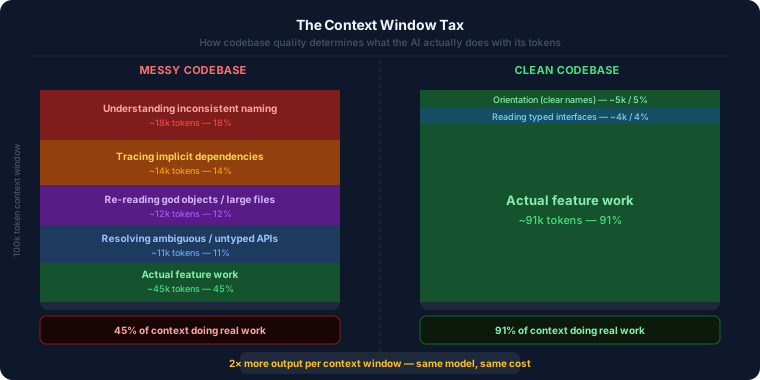
The diagram above isn't hypothetical. It reflects a real pattern: when you track how AI agents spend tokens in complex, multi-file sessions, a messy codebase burns roughly half the context window on orientation overhead before a single useful line gets written. A clean codebase spends less than 10% on orientation and uses the rest for actual work. Same 100k token window, twice the throughput.
Why this is different from regular technical debt
Technical debt has always had a cost. The old framing was: "it slows down engineers." Engineers who know the codebase compensate with tribal knowledge. New engineers take longer to onboard. Features take longer. Bugs are harder to track.
That was survivable because the slowdown was linear and human. A messy codebase made a 10-person team work like a 7-person team.
AI agents change the math in two ways.
First, they can't use tribal knowledge. An engineer who's been on a team for two years knows that handleData in services/user.js is the one you call, not the one in lib/user-helpers.js. The AI doesn't know that. It reads both, tries to infer the difference, and frequently gets it wrong. Every piece of implicit knowledge you've accumulated is invisible to the agent.
Second, they generate code at your codebase's pattern level. If the surrounding code is messy, the AI generates messy code. It pattern-matches to what it sees. Give it a codebase with consistent, well-named modules and it generates well-named modules. Give it a codebase with copy-pasted switch statements and any types everywhere and it generates more of the same. Fast. The AI doesn't compensate for your technical debt — it scales it.
Anthropic's 2026 Agentic Coding Trends Report found that 78% of Claude Code sessions now involve multi-file edits, up from 34% in Q1 2025. That number tells you everything: agents are no longer touching single files. They're traversing your entire codebase. The quality of that codebase — its naming, its types, its module structure — is now the primary variable in what they produce.
The compounding problem nobody talks about
Here's the thing that actually keeps me up at night: AI-generated code in a messy codebase makes the codebase measurably worse over time.
The agent doesn't refactor. It adds. It follows existing patterns. If your existing pattern is "dump it in utils.js," the AI happily dumps more stuff in utils.js. If your existing pattern is "any time something is unclear, reach for a global variable," the AI adds more globals. The very speed that makes AI coding compelling — it generates code in seconds — turns a mild tech debt problem into a serious one in a quarter.
The teams I've seen struggle most with AI adoption aren't the ones with bad prompts. They're the ones who adopted AI into a messy codebase and watched their velocity spike for six weeks, then plateau and start declining as the agent-generated mess became as hard to navigate as the original mess.
Speed without structure isn't acceleration. It's just faster entropy.
What it looks like in practice
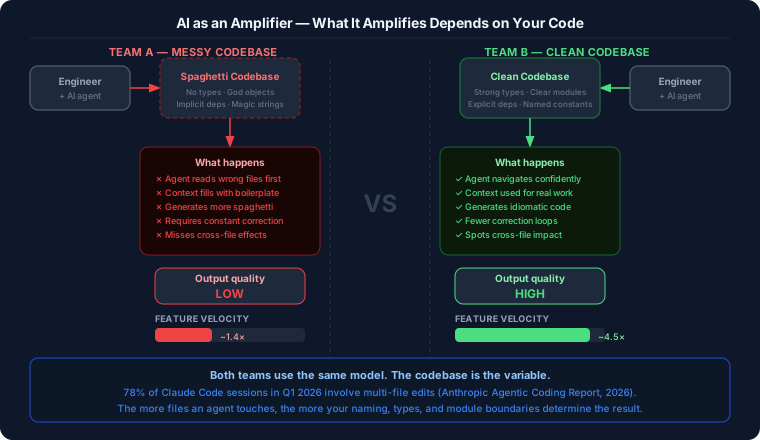
The velocity numbers in that diagram are directional, not precise benchmarks — your actual numbers will depend on the specific codebase. But the shape is right: a clean codebase with AI doesn't just match a messy codebase with AI. It runs away from it. And the gap widens over time because the clean codebase accumulates good AI-generated code while the messy one accumulates more mess.
This matters for founders and product people too, not just engineers. If you're budgeting for AI tooling and expecting a linear productivity lift, you're missing the bigger lever. The AI tools are a multiplier. What they multiply is your codebase. If your codebase is a 0.5, even the best AI tools get you to 1.0. A codebase that's a 2.0 gets you to 4.0 with the same tool.
The "refactoring budget" your engineering team keeps asking for? In 2026, that's your AI budget.
What to actually fix — and in what order
The good news: you don't need to do a big-bang rewrite. You need to fix the right things first — the ones that have the highest leverage for AI agent effectiveness.
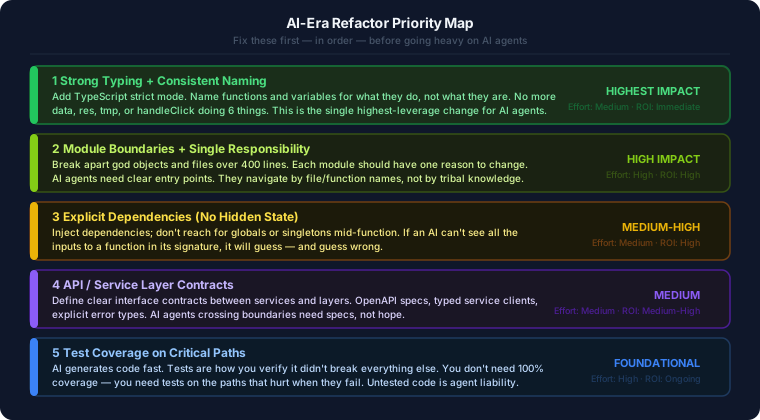
The priority order matters. Here's why each level works the way it does:
Naming and types first. This is where agents spend the most orientation overhead. A function named processUserData(data: any) tells the AI almost nothing. A function named applyDiscountRules(order: Order): PricedOrder tells it exactly what's happening, what it takes, and what it returns — before reading a single line of the body. TypeScript strict mode is the highest-leverage hour you'll spend on AI readiness.
Module boundaries second. Agents navigate by file. When you have clear module boundaries — a file per concern, not a file per developer's mood — agents can confidently identify the right file for a change and stay there. A 900-line file with six concerns forces the agent to read all of it to find the part that matters. A 120-line file with one concern takes seconds to parse.
Explicit dependencies third. Every global, every singleton reached for inside a function, every implicit dependency on environment state is a hidden input the agent can't see. Agents work best when the full set of a function's dependencies is visible in its signature. Dependency injection isn't over-engineering; it's making your code's requirements explicit — which is exactly what agents need.
API contracts fourth. If your codebase has service-to-service calls, add typed contracts. Not because the runtime enforces them, but because agents crossing service boundaries need to understand what they're working with. An OpenAPI spec or a shared TypeScript interface library gives the agent a map. HTTP calls into undocumented services give it a minefield.
Test coverage on critical paths last. Not because it's unimportant — it's foundational — but because tests are most valuable as a safety net after you've cleaned up the structure. Tests on a messy codebase just make the mess harder to change. Tests on a clean codebase let agents move fast without breaking things. The sequence matters.
The non-technical angle: this is a business decision
If you're a PM, a founder, or a CTO who doesn't write code daily, here's the translation:
Your company's AI productivity is roughly proportional to your codebase quality. This isn't a soft claim about developer happiness — it's a claim about how much output you get per AI API dollar and per engineer-hour.
You are already paying the tax. The question is whether you know you're paying it, and whether you're choosing to lower it.
The companies getting the most out of AI coding tools in 2026 didn't get there by finding a better AI assistant. They got there because they already had — or invested in — codebases where agents could operate effectively. The investment in clean architecture isn't competing with AI investment. It's the precondition for it.
The hot take close
The narrative in 2026 is that AI is making code quality irrelevant because you can just regenerate it. I think this is exactly backwards.
AI makes code quality more important, not less. When humans write code, they can intuit context from an entire codebase they've been living in for months. AI agents can't. They operate on what they can see in a context window. The quality of your code is the quality of the information you give them.
Every shortcut your team took in the last three years is now costing you tokens. Every implicit dependency is a guess the agent will eventually get wrong. Every magic string is a pattern the agent will cheerfully propagate across ten files in ten seconds.
The teams winning with AI aren't the ones with the best prompts. They aren't the ones who adopted Claude Code first, or bought the most expensive enterprise tier.
They have better codebases.
Stats sourced from Anthropic's 2026 Agentic Coding Trends Report and the HiveTrail analysis of the same dataset.
Work with me
I consult with engineering teams on AI adoption, cloud architecture, and engineering effectiveness. If this post surfaced a challenge you're facing, let's talk.
Get in touch →Related posts
Explore more on these topics: