The PM Who Ships: AI Agents Just Collapsed the Distance Between Idea and Production
The 6-week sprint was invented because execution was expensive. AI coding agents just made execution cheap. Here's what that means if you're a product manager.
The 6-week sprint was never a management philosophy.
It was a coping mechanism.
When building a feature costs $15k in salaries and two weeks on the critical path, you'd better be sure before you start. So you write specs. You groom backlogs. You estimate in story points with a straight face. You plan a sprint because the alternative — discovering you built the wrong thing — costs too much.
The sprint is a response to scarcity. When the cost of execution approaches zero, the whole apparatus looks different.
That's where we are now.
Why the Old System Made Sense (And Why It Doesn't Anymore)
Here's the honest version of the old PM workflow:
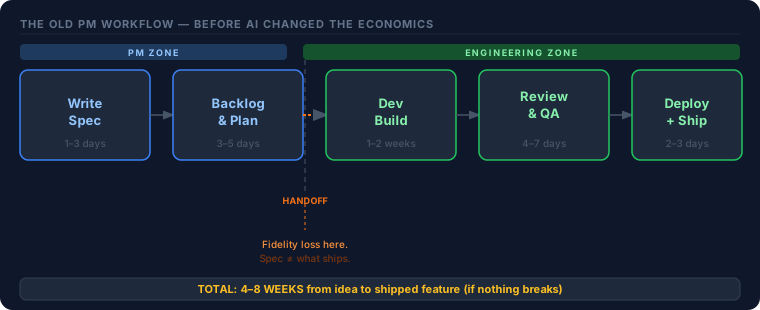
Every stage in that pipeline made sense in 2018. Specs exist because engineering time is precious and you want alignment before spending it. Backlog grooming exists because priorities change and half-built features are worse than unstarted ones. Sprints exist because focused two-week chunks are more efficient than context-switching every day.
The problem isn't the stages. It's the fidelity loss at handoff.
By the time a PM's idea reaches a deployed feature, it has passed through: a document, a ticket, a refinement meeting, a sprint plan, a developer's interpretation, a code review, a QA pass, and a deployment window. The idea that shipped is a fifth-generation photocopy of the original.
Most PMs have felt this. "That's not what I meant" said to a feature that took three weeks to build.
What Actually Changed
Anthropic published their 2026 Agentic Coding Trends Report with a number that stopped me cold:
27% of AI-assisted work is work that wouldn't have been attempted at all without AI.
Read that again. Not "we do the same work faster." A quarter of everything shipped now is net new output — ideas that previously died in the backlog because the cost of trying was too high.
The same report shows 78% of Claude Code sessions now involve multi-file edits (up from 34% a year ago). Average session length grew from 4 minutes to 23 minutes. Engineers accept agent-generated changes at an 89% rate when the agent explains what it did.
This is a shift in kind, not just degree.
For PMs: the implication is that you now have access to a tool that can build a working artifact in hours — not a Figma mock, not a slide deck, a running application — before asking engineering for anything.
The New PM Delivery Loop
Here's what the new cycle looks like when it's working well:
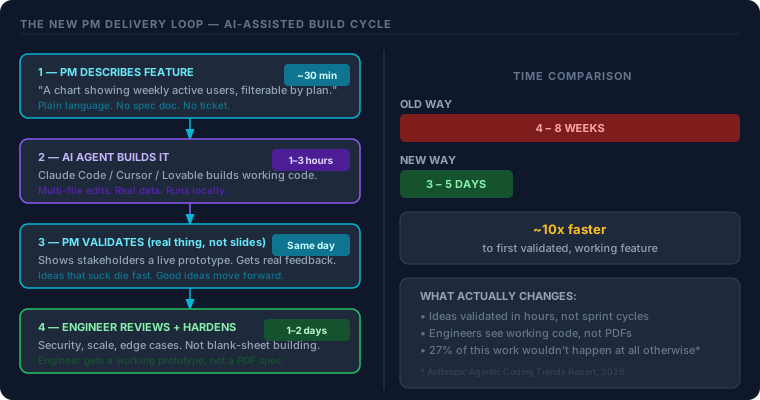
The difference isn't that everything is faster (though it is). The difference is that you validate with a real thing instead of a representation of a thing.
Showing a stakeholder a live prototype that actually pulls data from a real database is a completely different conversation than showing a Figma mockup. Objections become concrete. "I want the chart to show percent change, not absolute values" is something they discover by using it, not by reading a spec.
The feedback loop tightens from weeks to hours. Ideas that are wrong die fast. Ideas that are right move forward with momentum.
Which Tool for Which Job
I want to be direct about this because most "AI tools for PMs" lists are affiliate marketing in disguise. Here's what I've actually seen work:
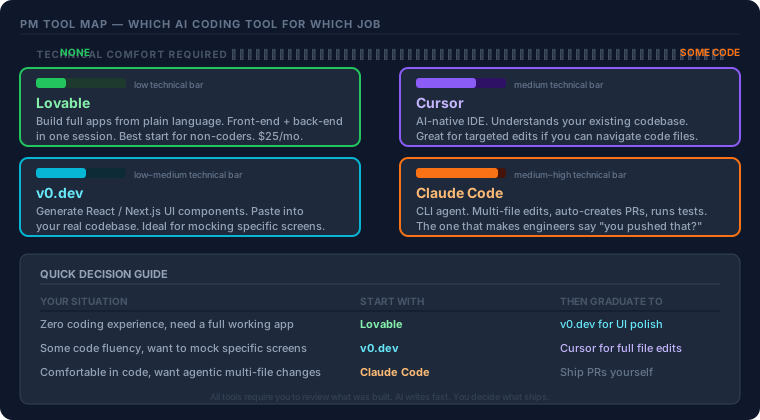
Lovable — If you have zero coding experience, start here. You describe your app in plain language; it builds a Supabase-backed full-stack application. Lovable 2.0 launched Agent Mode in early 2026, where the agent handles front-end and back-end in one session. $25/month. Best for: prototyping internal tools, SaaS ideas, anything you want to show stakeholders next week.
v0.dev (Vercel) — For UI components when your stack is React or Next.js. It doesn't build full apps; it generates high-quality components you paste into your real codebase. Best for: mocking a specific screen to show your engineering team exactly what you want, instead of "something like this but different."
Cursor — This one requires some comfort with code, but not much. It lives inside your code editor and understands your codebase. Best for: PMs who can read code and want to make targeted changes (edit copy, fix a label, adjust a layout) without opening a ticket.
Claude Code — CLI-first, agentic, and significantly more powerful than the others for multi-file changes. If you can navigate a terminal and understand git basics, this is the one that makes engineers ask "did you just push that yourself?" Best for: non-trivial feature prototypes that touch multiple files, automated PR creation, running your test suite.
The pattern: start with Lovable if you need a full app from scratch, graduate to Claude Code when you're working in an existing codebase.
What This Means for Engineering Teams
I want to be specific about this because it's where the conversation usually goes sideways.
This doesn't replace engineers. It changes where engineers get involved.
The old model: PM writes spec → engineer builds everything → PM reviews a finished feature they've never touched.
The new model: PM builds a rough working version (hours) → validates the idea is worth polishing → engineer takes the working prototype and makes it production-grade.
Engineers don't do less work. They do higher-leverage work. The CRUD screens, the boilerplate, the "can we just change this button to say Submit" tickets — those go away. What remains is the work that actually requires engineering expertise: security architecture, performance at scale, cross-system integrations, data model decisions.
The engineers who feel threatened by this are the ones who wanted the spec-to-ticket-to-PR assembly line to stay intact. The engineers who thrive are the ones who always wanted to solve hard problems and were tired of explaining why the dropdown should be a combobox.
For PMs, the shift is equally real. Writing a 10-page PRD for a feature nobody has validated is a liability masquerading as rigor. The PM who can build a working version and bring evidence to the engineering conversation is more useful to everyone.
Where This Still Breaks (Don't Get Cocky)
I've watched PMs ship things they shouldn't have. Cautionary notes:
Security and auth changes. AI agents will happily build you an authentication flow that works but is subtly wrong. JWT handling, session management, permission checks — these need an engineer who understands your security model. Full stop.
Anything touching payments or PII. Same reason. A prototype that "works" is not a prototype that's safe to put real credit card data into.
Database schema changes on production tables. AI will write you a migration that looks reasonable and might silently drop an index your largest query depends on. Engineers review these.
API changes other systems depend on. The agent can't know which of your 12 microservices calls that endpoint.
Infrastructure and scaling decisions. A prototype that works for 5 users doesn't automatically work for 50,000. That's engineering.
The rule I tell PMs: use AI to validate whether the idea is worth building. Use engineers to make it worth shipping.
The Shift That's Actually Happening
The 6-week sprint cycle was designed for a world where you had one shot to get it right because building was expensive. In that world, specs, grooming, and estimation were rational responses to constraint.
In a world where a PM can have a working prototype in an afternoon, the economics change. You can run experiments that used to require a full sprint. You can kill bad ideas before they consume two weeks of engineering. You can ship things in the same week you had the idea, then improve them based on what you learn.
That's not a productivity hack. It's a different way of working.
The most dangerous PM in 2026 isn't the one with the most detailed roadmap. It's the one who doesn't need a sprint to find out if an idea is worth having.
Tools referenced: Lovable · v0.dev · Cursor · Claude Code
Work with me
I consult with engineering teams on AI adoption, cloud architecture, and engineering effectiveness. If this post surfaced a challenge you're facing, let's talk.
Get in touch →Related posts
Explore more on these topics: